Nobel laureate Geoffrey Hinton, one of the “godfathers of AI,” said in an interview, “I am worried that there’s going to be massive job losses and that would be good if the increase in productivity made us all better off. Big increases in productivity ought to be good for people but in our society they make the rich richer and the poor poorer.”
Dr Hinton, Nobel prize worth smart and intelligent, gets this wrong. True, that an increase in inequality could mean that the rich get richer and the poor poorer. But that is not necessarily so, has never been so, and is unlikely to be so.
No matter how hard one tries, it will be impossible to argue that the poor are getting poorer. Anyone who claims that — Nobel winner or not — is either ignorant or lying.
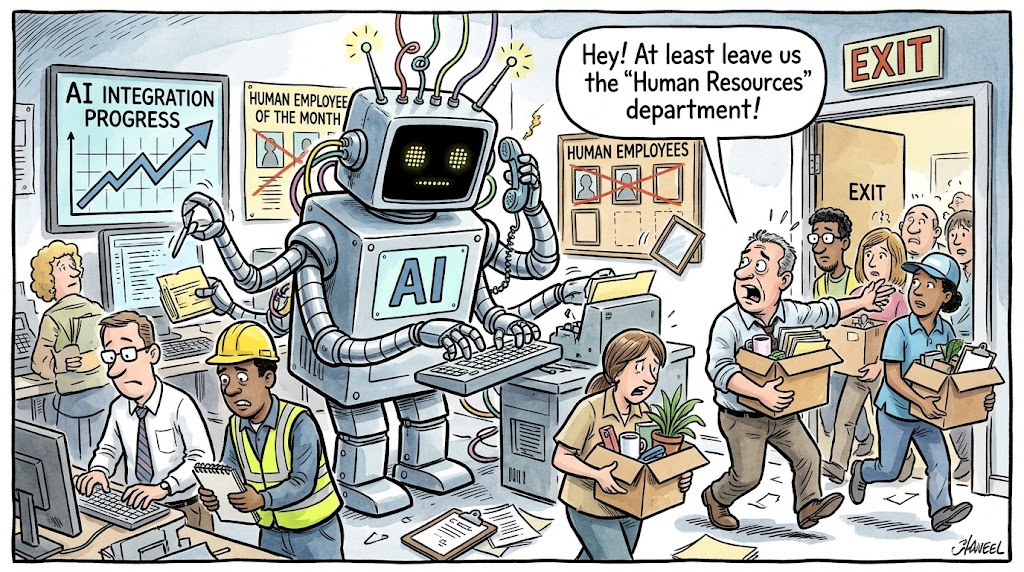
The cartoon at the top of this post was created by Gemini. I gave the prompt but I could not have created that cartoon even if were to spend a couple of days trying to do that. Continue reading “Hauled from the archives: AI and Jobs”

 I find two concepts deeply mysterious and puzzling. One of them is the nature of consciousness, and the other is the nature of time. Both have been investigated by philosophers (particularly by sages in India) for at least a couple of thousand years, and Western philosophers and physicists have struggled to make sense of them for the last few centuries.