In a license control quota permit raj, the link between big businesses and the government is bi-directional. The government hands out licenses in exchange for part of the loot that the businesses make from their monopolistic businesses.
Just the other day a friend was telling me how one major business house (starts with a B) used to give freebies to one of India’s prime ministers (starts with a N). N would be hosted and feted by B, and in exchange, N made sure that B got licenses for steel or some such commodity, and was protected from market competition.
That’s crony capitalism. The cronies are usually leftist politicians and big businesses. N got the game started and with time, the rot has spread.
India has suffered immeasurably from it. There’s of course the direct loss which arises from mis-allocation of resources, and under-utilization of capacity. Given protection from domestic and foreign competition, firms end up producing high-cost shoddy goods. The consumers lose in terms of quality and quantity.
India has been DUPed. DUP is an acronym for “directly unproductive profit-seeking” activities, authored by the venerable Jagdish Bhagwati (in a 1982 paper). Here’s a bit from his book “Political Economy and International Economics.” (MIT Press, 1991.)
Directly unproductive profit-seeking (DUP) activities are defined as ways of making a profit (i.e., income) by undertaking activities that are directly (i.e., immediately, in their primary impact) unproductive in the sense that they produce pecuniary returns but do not produce goods or services that enter a conventional utility function or inputs into such goods and services.
Typical examples of such DUP (pronounced appropriately as “dupe”) activities are (1) tarrif-seeking lobbying that is aimed at earning pecuniary income by charging the tariff and therefore factor incomes, (2) revenue-seeking lobbying that seeks to divert government revenues towards oneself as recipient, (3) monopoly-seeking lobbying whose objective is to create an artificial monopoly that generates retns, and (4) tariff-evasion or smuggling that that de facto reduces or eliminates the the tariff (or quota) and generates returns by exploiting thereby the price differential between the tariff-inclusive legal and the tariff-free illegal imports.
While these are evidently profitable activities, their output is zero. Hence, they are wasteful in their primary impact, recalling Pareto’s distinction between production and predation: they use real resources to produce profits but no output.
The above quote is (laboriously) copied from the google book cited above.
We have to keep in mind that perhaps it all starts innocently enough. Well-meaning people who are seriously ignorant of the basic nature of the world make policies that they believe will benefit society as a whole. Businesses soon enough realize that more profits can be made by gaming the system than by actually producing value and generating wealth. With time, the waters get sufficiently muddy that DUP activities become hidden from public view and finally entirely disappear from public consciousness.[1] The economy slides into poverty.
The world used to be divided into largely independent domestic markets. Now, however, with increasing globalization, DUP activities are international in character. One of the most profitable is the global arms market. The US arms businesses prowl around the world selling multi-billion dollar deals to Third World countries.
Rediff.com reports that the US government
has launched a concerted and aggressive campaign on behalf of United States’s fighter aircraft manufacturers to push for the ‘mother of all deals’– the $11 billion medium multi-role combat aircraft deal for 126 fighter aircraft for the Indian Air Force. The deal could give the ailing US economy a major boost in terms of both exports and thousands of jobs.
[Thanks to Yoga Saripalli for the link.]
These are truly weapons of mass destruction, as I have been saying for a while. The true weapons of mass destruction are the guns and fighter planes and subs and ships that are routinely sold. A few squadrons of fighter planes send millions to an early grave — not as dramatic as a mushroom cloud but more painfully through chronic starvation and disease.
Here’s a bit from a post from April 2009, “The War and the Circus.”
Perhaps most humans are congenitally belligerent and can be reasonably expected to get into fights. But it takes institutionalized big businesses to create a war machine that raises ordinary human belligerence to levels of superhuman insanity. The war machine — and one can argue that indeed there is only one such thing but with a global reach, even though its components are multinational in the sense that people from various nations participate in their creation and maintenance — is so pervasive that it seems to be as natural, unchangeable, and logical as the seasons. Like the seasons, the war machine dictates how people carry on with their lives unquestioningly. People generally accept the war machine as naturally they do the seasons.
But if one stops to think about it, unlike the seasons, the war machine is entirely man-made. The men (and they are overwhelmingly men, regardless of the color of their skins or their eyes) in charge of the military-industrial complex create the war machine for their own amusement and aggrandizement. They have the power to create ever more lethal, ever more expensive components of the war machine, and that power extracts ever more resources from the global economy to ratchet up the destructive power of the machine monotonically. The machine almost literally sucks up life out of the people who have no power over it but who eventually pay for it with their blood, sweat and tears. The men controlling the machine, however, get more of what motivates them — raw, naked, unimaginable power.
Every nation on earth is involved in this insanity, directly or indirectly. The desperately poor third-world nations starve their own people to buy ever more expensive weapons from the advanced industrialized countries. By keeping these nations fighting amongst themselves, the advanced industrialized countries achieve two goals. First, income.
The desperately poor third-world nations pay the advanced industrialized countries for weapons they cannot afford. If one side of a particular conflict involving two desperately poor third-world countries is unable to afford the weapons, the advanced industrialized countries give out “aid” to prop it up so that it does not lose and thereby end the conflict. The other side, to maintain balance, then has to become a paying customer and buy an equivalent set. This is a source of income for the advanced industrialized countries, and more damagingly, a transfer of wealth from the desperately poor to the amazingly prosperous.
Go read that post when you have time. It is depressing as all hell, even if I say so myself. And if you want more, go check out this old post, “Wars, Opium, Powerful Governments and Weak Nations” which is from December 2005.
Before I let you go, here’s another one on the same topic from long ago which I recommend. “Benefits of Weapons Trade” July 2005.
The US had passed its age of being a subsistence economy for a long time before it started on its path to developing weapons of mass destruction. Its agriculture was booming, it had a huge manufacturing base, its people were literate and educated, it had a massive stock of housing, its institutions were mature, and so on. Given that foundation, it could afford the luxury of going into the research and development of weapons, and built the most advanced and expensive military hardware in world. The unfortunate part is that there are countries like India which have hundreds of millions of people stuck in the subsistence phase of development. And the leaders of these under-developed countries eye the expensive military hardware and salivate. They are forced to attempt to keep up with their neighbors in their competition to get as many shiny nuclear-tipped missiles as possible.
If I was made the global dictator temporarily, and was given the power to make only one absolutely binding and enforceable global law, it would be to ban weapons trade altogether. If neither India nor Pakistan could buy nuclear subs and missiles, fighter jets and bombers, the ordinary people of these countries might have a better shot at a human existence.
From this point of view, the tragedy of the world is not so much that there are so many poor countries, but that there are those rich countries that have surplus resources to devote to developing weapons that ultimately starve the poor. And the leaders of these poor countries fall all over themselves in praising the foresight and the wisdom of the leaders of the rich countries for giving them the opportunity to buy these weapons.
Mark Twain had unusually praiseworthy words for India. He would have been pleased by the increased tries between India and the US. But I am sure that he would have been saddened by the irony in the celebration of some in India at the chance to buy American weapons.
NOTES:
[1] Go read “You can’t trust the Tatas, they are worse than others,” a post by Girish Nikam at “Indias Report.” (Thanks to Dinesh Dharme for the link.) Murky business. Who knows what’s going on in one of India’s most respected business houses. But we should not be surprised.

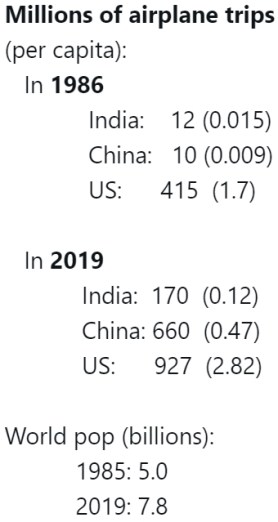 Thanks to the wonders of socialism and communism, China was either at par with or poorer than India for most of the 20th century CE. However, in 1978 China’s luck changed when Deng Xiaoping took over. Deng was a pragmatist, had the capacity to learn and do what needed to be done — make China great again.
 Atanu Dey : Life is a Random Draw