
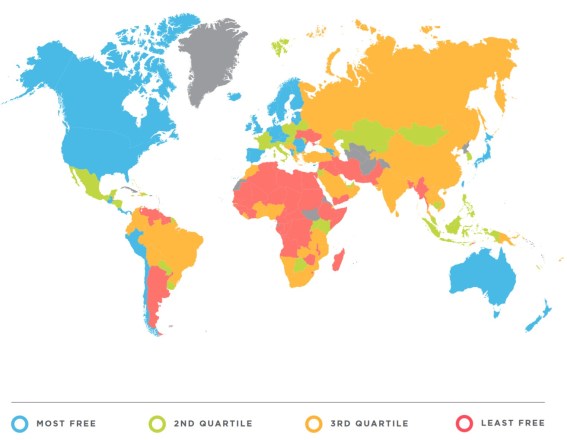
 The Economic Freedom of the World Annual Report 2022, published by the Fraser Institute, is available for download (pdf) here. It reports on the economic freedom for the year 2020. The exec summary begins with: Continue reading “Economic Freedom of the World 2022”
Category: Economics
Value, Price, and Cost
 Often used interchangeably, the three concepts — cost, price, and value — are related but distinct. They are elementary and understanding them precisely is essential for reasoning about our world of production, exchange and consumption. People, including yours truly before learning economics, don’t even realize that they are confused about those simple concepts.
Let’s begin with value since it’s personal and therefore most intuitive. I want what I value, and vice versa. In nearly all cases, I have to give up something (S) in exchange for what I want (W). Logically, I must value S less than I value W if I do the exchange voluntarily. It would be irrational for me to give up something of greater value in exchange for something of lesser value to me. Continue reading “Value, Price, and Cost”
Maintaining Agreement
 “And the main, most serious problem of social order and progress is . . . the problem of having the rules obeyed, or preventing cheating. As far as I can see there is no intellectual solution of that problem. No social machinery of “sanctions” will keep the game from breaking up in a quarrel, or a fight (the game of being a society can rarely just dissolve!) unless the participants have an irrational preference to having it go on even when they seem individually to get the worst of it. Or else the society must be maintained by force, from without — for a dictator is not a member of the society he rules — and then it is questionable whether it can be called a society in the moral sense.”
Frank H. Knight. “Intellectual Confusion on Morals and Economics” (Jan 1935. The International Journal of Ethics.) Continue reading “Maintaining Agreement”
What is Wealth?

“The serious fact is that the bulk of the really important things that economics has to teach are things that people would see for themselves if they were willing to see. And it is hard to believe in the utility of trying to teach what men refuse to learn or even seriously listen to.” — Frank H. Knight
Conflating the words money and wealth is an easy mistake to make because in most everyday parlance we use the two interchangeably — if you are wealthy, you have a lot of money, and if you have a lot of money, you are wealthy — without loss of comprehension.
But money is a measure of wealth, not wealth itself, just like kilogram is a measure of mass but is not itself mass. They are not the same. They have to be distinguished if we are to reason cogently about the nature and causes of wealth of people (and progress in our “inquiry into the nature and causes of the wealth of nations.”)
I have written a fair bit about wealth and money over the years. Time for a TL;DR version. Continue reading “What is Wealth?”
IRS

I love IRS. Not the “Internal Revenue Service” but “increasing returns to scale”.
Understanding the economic concept of “returns to scale” is useful for understanding the tremendous increase in the production of wealth in our modern world.
A bit of vocabulary first. The stuff that goes into production are called “factors of production.” The vocabulary is the same as in basic arithmetic where the product is derived from factors — for instance, the factors 2 and 3 when multiplied yield the product 6.
When you increase the factors, the product increases. That is, the “scale” or the size of the operation increases and therefore the product increases. If the increase in production is proportionate to the increase in the factors, then we have “constant returns to scale.” Continue reading “IRS”
CORE – The Economy
It’s hard to overestimate the importance of public understanding of the fundamental principles of economics and some of the many uncontested facts (facts that are generally accepted by acknowledged peers of experts) of economic history. The lack of public understanding — worse still a misunderstanding — invariably leads to awful misery that could have been avoided by teaching the public a few essential details of the nature of our social world and how it works.
We have to be taught and we have to learn how to think about our world, just like we have to be taught how to read, write, reason logically and do arithmetic. Unlike comprehending and speaking natural languages, we cannot instinctively read, write, reason or do arithmetic; we have to learn. Reading, writing and doing arithmetic is “unnatural.”
Let’s recognize that the basic principles of economics are unnatural and therefore run counter to our intuition. Our natural instincts lead us to think and believe in ways that are almost always at odds with the facts and the true nature of our economic (therefore social) world. Briefly stated, this is so because our instincts evolved over evolutionary time-scales of tens of millions of years when humans lived in small groups of a few dozen people, hunting, gathering and foraging to survive. Only in the very recent past of around 200 years — the blink of an eye compared to hundreds of thousands of years — the world changed so dramatically that nearly everything that made sense in the long past was rendered totally irrelevant and wrong. Continue reading “CORE – The Economy”
Economists as Camp-following Whores
 “The inverse relationship between quantity demanded and price is the core proposition in economic science, which embodies the presupposition that human choice behavior is sufficiently relational to allow predictions to be made. Just as no physicist would claim that “water runs uphill,” no self-respecting economist would claim that increases in the minimum wage increase employment. Such a claim, if seriously advanced, becomes equivalent to a denial that there is even minimal scientific content in economics, and that, in consequence, economists can do nothing but write as advocates for ideological interests. Fortunately, only a handful of economists are willing to throw over the teachings of two centuries; we have not yet become a bevy of camp–following whores. “
That’s a favorite quote from James M. Buchanan. He wrote that in the 1990s in response to a Wall Street Journal interview in which the disemployment effect of minimum wage legislation was questioned.
The theoretical case that minimum wage laws adversely affect low-skilled workers is as sound as anything else in economics. The empirical evidence is also as sound as the empirical evidence for “dog bites man.” What makes the news is when “man bites dog.” That exception does not invalidate the general case that dogs bite men. Continue reading “Economists as Camp-following Whores”
On Monopoly
 “I am confused about the correctness of government interference to break monopolies. Sometimes I think this is good. I do believe that a free market without competition is terrible. But if the government starts deciding what a “monopoly” is and what is not, we have just let in a thin wedge that can corrupt free markets beyond any limit. But then, if the government does not break monopolies, who will? Can the free-markets self-correct? Has it ever happened in practice?”[1]
Those are not easy questions to answer in a blog post since the issues involved are many and far from trivial. Volumes have been written on the definition and analysis of the economic concept of monopoly, and experts frequently disagree on what, if any, harm monopolies do, and what should the policy response be.
My thinking has evolved since I first began learning economics. Trained in the neoclassical tradition, I used to think that monopolies were harmful for the economy, and therefore government intervention was required to break them up for economic efficiency and consumer protection. However, the more I studied Austrian economics, the more I realized that monopolies weren’t the great threat to economic health as they were made out to be. Continue reading “On Monopoly”
Honoring Those Who Serve Us
 I came across an interesting bit in a video I was watching yesterday. “How many health care providers are in the room?” asked the kind lady in it. After a show of hands, she said, “Thank you, thank you, thank you. I feel like a lot of the work both of us care about so much is in service of others and all of you are dedicating your life for that same purpose.”
The dedication to the “service of others” part caught my attention. It’s curious that healthcare providers such as doctors and nurses, and other people like firefighters, military personnel, etc., are popularly held in higher esteem than sanitation workers, bus drivers, computer programmers, sales people, etc. Somehow some occupations are more “selfless” than others. Sorry to be contrarian but it’s simply not true that occupations can be categorized that way.
Certainly occupations can be justifiably categorized as immoral or moral, legal or illegal, intellectually hard or easy, physically challenging or easy, and so on. But as long as one is getting paid and not doing voluntary work, there’s no selflessness involved. That is not to imply people in various paid occupations are narrowly selfish and lack human decency; it is only that all of us are most of the time primarily — though not solely — motivated by self-regard and not by self-denying altruism. Continue reading “Honoring Those Who Serve Us”
People, the Ultimate Resource
 Quite often I enjoy the pleasure of shocking people with my contrarian viewpoints. For some people, the shock is replaced with the pleasure of understanding something that goes against plain common sense. When that happens, I am very gratified but when it doesn’t, I feel sad.
One of the many contrarian ideas I have is that there are no “natural” resources and that all resources are creations of the human mind. As economist and professor of business administration Julian Simon (1932 – 1998) argued that “the most important of all resources is human beings.” (The Ultimate Resource 2. Page 581). The more humans, he insisted, means more abundance and less scarcity.
We are all concerned about facing scarcity. Not all of us face the same scarcity, though. The good news is that scarcity is going down. To understand why that is so requires we define scarcity in some broad sense. We intuitively understand that prices have something to do with scarcity.
If the price of something is going up, it means that (1) the quantity available is decreasing, or (2) the quantity demanded is increasing, or (3) a combination of both. If the price is trending up, it is likely that scarcity is increasing, and vice versa. The price trend is a proxy measure of scarcity. If the trend is falling prices, then we conclude that scarcity is decreasing. Continue reading “People, the Ultimate Resource”
 Atanu Dey : Life is a Random Draw