
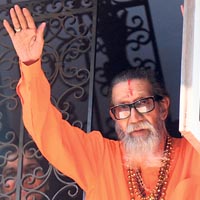
Shri Balasaheb Thackeray passed away today (Saturday afternoon India time) in Mumbai. Much of what I know about current events, I learn from the handful of people I follow on twitter. So I got to know of Balasaheb’s death through twitter. I noticed quite a few “RIP” messages. That prompted me to write a few tweets myself.
My first tweet on the matter was
- RIP is appropriate for Christians, not Hindus. Dharmic beliefs don’t involve souls resting till judgement day.
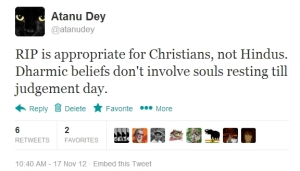
Here is a picture of my twitter time line where I state why RIP is not appropriate for those who follow the dharmic traditions (Hindu, Jain, Buddhist, etc).
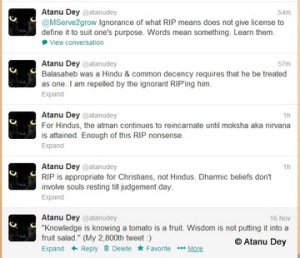
Since the image is hard to read, here’s what the tweets say:
- For Hindus, the atman continues to reincarnate until moksha aka nirvana is attained. Enough of this RIP nonsense.
- Balasaheb was a Hindu & common decency requires that he be treated as one. I am repelled by the ignorant RIP’ing him.
- Ignorance of what RIP means does not give license to define it to suit one’s purpose. Words mean something. Learn them.
Avoid Resting in Peace
“Rest in peace” or its Latin original “requiescat in pace,” implies the belief that at death the body is separated from the soul, and while the body lies buried the soul rests elsewhere until the final day of judgement when some “god” unites the body with the soul and then assigns some to “heaven” and others to “hell.”
I find the whole notion of heaven and hell, and its necessary correlate of a judgmental “god” who hands out eternal rewards and punishments, utterly insane and repulsive. It’s all very fine for people who profess the Abrahamic faiths to wish their co-religionists RIP but others would do well to respect people of different faiths and not wish them RIP.
Material versus Cosmological Beliefs
In response to my tweet about RIP, Satish Jha (@satish_jha) tweeted
@atanudey True. But what’s so Hindu about anything we do, say, read, write, wear, consume. Am shocked at conversion of India into vChristians
I suppose “vChristians” means “virtual Christians.” Satish perhaps meant it rhetorically but it raises an interesting question: does what I read, write, wear and consume make me a Hindu? I read and write in English, I wear Western style clothing, I live in a Western country, etc. Even then I am a Hindu at the core of my being.
What defines me as a Hindu is my core belief system. How I comprehend the world is what determines whether I am a Hindu or not. The important distinction here is between “material beliefs” and “cosmological beliefs.”
Material beliefs relate to the everyday matter of how to make a living, while cosmological beliefs relate to how should one live. The former is informed by the physical and social sciences (which in my case happens to be economics) and the latter by philosophy. My cosmological beliefs define me as a Hindu. I understand, appreciate and subscribe to the ideas of maya, dharma, karma, moksha and so on.
Even though I have adopted material beliefs that appear to be Western, that does not mean that I have to abandon my cosmological beliefs. They are not in conflict and they are certainly not mutually exclusive. What I wear or the language I speak are superficial features that can mislead those who can only see the surface (and not what lies beneath) into thinking that I am a “virtual” something or the other that I am actually not.
(I write “material beliefs that appear to be Western” — the stress is on the word “appears” — because there’s nothing Western about economic and individual freedom. India has a long tradition of that and only recently has it been eclipsed by socialism. This too shall pass.)
While I have put the above in personal terms, it has relevance for India as a whole. India needs economic development and that would require Indians to change their material beliefs. Indians must understand that material poverty is an unavoidable consequence of wrong ideas of “how to make a living.” But changing their material beliefs will not require them to change their views on “how to live.” Poverty is not a core defining feature of being a Hindu, although Gandhi (and his followers) may insist that they are congruent.
Getting back to Shri Balasaheb. “Namaste and Om Shanti,” Shri Balasaheb.
Nama and Rupa
Pondering the fact of death, I am reminded that impermanence is a central feature of the world we live in. The phenomenal world — of things and events — is called maya in the dharmic traditions. The world is maya. Many people simply translate it as “illusion” but that is incorrect. The world is real. Maya does not mean that the world is unreal or that it is an illusion. It means something like this: the world as we perceive it is not what the world actually is. That reality is given a word — Brahman. Most of us cannot comprehend the Brahman because we are limited beings.
That is, our perception is imperfect or incomplete, and the model of the world we build in our brains is not what the world is. Neti, neti. Not that, not that. Alan Watts explained maya nicely.
. . . the maya doctrine points out, firstly, the impossibility of grasping the actual world in the mind’s net of words and concepts, and, secondly, the fluid character of those very forms which thought attempts to define. The world of facts and events is altogether nama, abstract names, and rupa, fluid form. It escapes both the comprehension of the philosopher and the grasp of the pleasure-seeker like water from a clutching fist. There is even something deceptive in the idea of Brahman as the eternal reality underlying the flux, and of the atman as the divine ground of human consciousness, for in so far as these are concepts they are incapable of grasping the real as any other.
The idea that words are incapable of fully defining reality is a central defining feature of dharmic traditions. We have to use them but we should not confuse them for what they represent. The map, as they say, is not the territory. Words are symbols and they have their utility but if imperfectly understood, they can be a hindrance to the ultimate goal — that of liberation, variously known as moksha or nirvana.
Alan Watts again, on moksha:
Moksha is also understood as liberation from maya—one of the most important words in Indian philosophy, both Hindu and Buddhist. For the manifold world of facts and events is said to be maya, ordinarily understood as an illusion which veils the one underlying reality of Brahman. This gives the impression that moksha is a state of consciousness in which the whole varied world of nature vanishes from sight, merged in a boundless ocean of vaguely luminous space. Such an impression should be dismissed at once, for it implies a duality, an incompatibility, between Brahman and maya which is against the whole principle of Upanishadic philosophy. For Brahman is not One as opposed to Many, not simple as opposed to complex. Brahman is without duality (advaita), which is to say without any opposite since Brahman is not in any class or, for that matter, outside any class.
Now classification is precisely maya. The word is derived from the Sanskrit root matr-, “to measure, form, build, or lay out a plan,” the root from which we obtain such Greco-Latin words as meter, matrix, material, and matter. The fundamental process of measurement is division, . . . Thus the Sanskrit root dva- from which we get the word “divide” is also the root of the Latin duo (two) and the English “dual.”
To say, then, that the world of facts and events is maya is to say that facts and events are terms of measurement rather than realities of nature.
Just by the way, Alan Watts (1915-1973) is a favorite teacher of mine. He explains many basic concepts of Hinduism and Buddhism in terms that I find accessible. Philosophically I place myself in the advaita (non-duality) school, which I think is what unites Hinduism and Buddhism, the two great traditions of India. As Watts puts it, Buddhism is Hinduism stripped for export.

 Atanu Dey : Life is a Random Draw
Great post, especially the description of the Hindu philosophy. The whole RIP thing confirms the notion that “language is a vehicle of a culture”.
In other words language has deep cultural connection to it. Cultural events needing description in England were and are different then those in India. Spoken language is not like computer language such as C++ which is same anywhere in the world.
Context matters !!! And in case of spoken language the context is culture which is obviously intertwined with religion.
In India if you must write in English write in terms that has the proper cultural context.
I severly detested what Bal Thackrey’s party stood for but on the day of his passing for the sake of decency I must offer condolences to his family.
LikeLike
Atanu — You use the term reincarnation in one of your tweets. You also use Brahman and Advaita. What are these things? Have you experienced these things for yourself are these simply concepts for you too, as Alan Watts suggests? I don’t ask this in a confrontational way. I do understand impermanence — that is a fact of everyday life and I can verify it, both in my mind, body and the world outside.
To me, personally, reincarnation and brahman mean nothing, although they sound very grand; I’d like to know if they are true or not. If they are only concepts for me, then I don’t see a difference between reincarnation and the concept of heaven. Both are just that: concepts.
The only reality I know is the one that my senses in conjunction with my “mind” allow me to experience. Is there anything outside of it? I have no idea; I cannot disprove anything of course, but I really have no idea. What if this is all that is there?
The problem is that many of us — myself included — conveniently believe in this Hindu/Buddhist jargon that is fed to us. Oneness/Non-Duality/Advaita are very attractive concepts, but the I personally know only duality. No matter where I turn, my “I” is there and so is the “world” that is separate from me.
LikeLike
Atanu,
Isn’t Hinduism also judgmental in that your ‘karma’ (net sum of “good” and “bad” deeds) gets accumulated and affects the kind of life one leads in future incarnations?
Also, it would be great if you could clarify whether there is any particular reasoning behind you believing in Advaita / Brahman etc. (as opposed to say just being a materialist) other than a blind faith in the Upanishads etc.? (just rephrasing Hari’s question above)
I’ve been following your blog for 5 years now. You’ll perhaps feel happy to know that it has been a great source of learning for me in all kinds of things — philosophy, science, economics, politics — of which I knew nothing having been taught by mediocre teachers at schools with meager infrastructure. If you don’t mind a bit of feedback, here’s my two cents. I find your posts about philosophy, science the best. While I understand that you subscribe to Milton Friedman school of economics, I was surprised to find very little discussion about the recession and the subsequent debate about the role of government. (bailout etc)
LikeLike
What bothers me more than his death is the obsession with him…All this treatment as if he is a demi-God. When rowdy robinhoods are worshipped, it reflects something of the culture. I guess this is again a fall out of the poverty we live in. When governments fail, sahebs like these become heroes…
LikeLike
Exactly @Yoga!!
Lot of businesses are closed, some for almost 2 days for the “mourning” of the passing of “Dear Leader”. This North Korea style strongman dictatorial culture begets North Korea style poverty.
What is the total amount of economic activity denied to law abiding citizens because of this thug? The economic cost of having a thug like this destroying commerce on his whims is astronimical. Its a shame that thug like this is lionized.
LikeLike
I have no problem with balasaheb but what is right now happening in india shows the cult worshipping qualities of indians.
The way people worship balasaheb , the same way jhollawals worship the gandhi-maino clan.
IMO,this is the reason we as a society have never been able to retrospect what is wrong with our economy.
LikeLike
For anyone interested, the concept of Maya is extensively described in the book “Maya in Physics” by N C Panda. It is worth a good study.
LikeLike
Robert Vadra got it right when he said that India is a banana republic.
Now a 21 year old girl is arrested for question Mumbai’s shutdown after Bal Thackeray’s death:
http://timesofindia.indiatimes.com//articleshow/17276979.cms?intenttarget=no
It is the same Mumbai police that arrested a cartoonist two months back but was never able to arrest Bal Thackeray himself for his hate speeches.
LikeLike
This terrorist who just died is still causing fears in politicians. Look Girl arrested for questioning the Mumbai shutdown.
This is the clinching proof that India is actually Soviet Union with elections.
It is so pathetic that they have to arrest girls for expressing their views on facebook.
Amazing what terror can do.
LikeLike
I love Satish Jha’s “vChristian” term. Plenty of Bollywood movies show the hero and heroine in what does not look like a Christian household or society at all, and they romp off to a church to get married! Here’s an excerpt from a recent DNA article about children and fairy tales. It’s unreal in its vChristianity or vCaucasianity:
“As my toddler son discovered the wonderful world of storytelling, I treated the two of us to a collection of fairy tales, stories that you and I, and possibly every school-going child in the world are familiar with, stories like Rapunzel and Hansel and Gretel. […] the darker side of such tales and what do you expect from authors that call themselves Brothers Grimm, but believe me, you don’t want to explain to a two-and-a-half-year-old why someone would want to steal a baby to punish someone for stealing from their garden! Yes, that’s the setting of the lovely-blonde-hairwashed-sweet-smelling Rapunzel story. And imagine telling your kid the story of a father who plots to abandon his children in the forest — it totally makes sense to me why my parents never read Hansel and Gretel out to me when I was a kid: It was probably out of kindness.“
LikeLike
i expected this post to be like the one you wrote on RAJ T who’ll now try to fill the vaccum. But this info abt RIP was still interesting but I’ll go with mark twain and sam harris kinda view – after death it’s NOTHING.
Some blogs have glorified this crook as hindu samrat etc. Then they deduce that india is a land of ppl who has hindu ancestors so technically he divided hindus themselves – marathis VS southerners and then the baby cub goes after northerners. Justice katju has a good one on this guy.
http://justicekatju.blogspot.no/2012/11/why-i-cant-pay-tribute-to-thackeray.html
LikeLike
Atanu,
A very good post. Would love to read more about Hindu -Sanatan Dharma- philosophy. Will appreciate if you write more on this subject in
near future.
LikeLike
Good riddance to bad rubbish. People have sang paeans about his role in being the counterweight to the Muslim mafia in Bombay among other things. But the man was a brute; to put it in plain terms. In addition to that he was a hypocrite; to project oneself as a renunciate (saffron robes, rudraksha necklace etc) while being involved fully in politics is nothing but hypocrisy. Worse, he is responsible for millions of Maharashtrians to be thrown back in the course of evolution by a few hundred years with his Marathi Manoos bullcrap that they gladly lapped up.
LikeLike