
Here’s a graph from the Pew Research Center which shows the percentage of people of various religious backgrounds (living in the US) who agree that evolution is the best explanation for the origin of human life on earth.
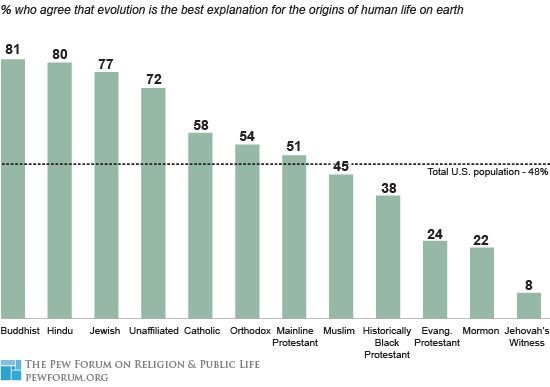
Buddhists and Hindus are — not surprisingly — at the top of the heap. Why? Because these two non-monotheistic religions are based on the rational idea that change is an inherent characteristic of the universe and that change is evolutionary. Just to illustrate the point that the idea of evolution is central to Hinduism, consider the Ten Incarnations of Vishnu. The sequence is as close a guess as anyone with little modern scientific understanding but with great intuition could have come up with. Vishnu’s first incarnation is a fish; then an amphibian; then a land animal; then half-man-half-lion; then a dwarf human; then a warrior; then a prince; then a god; then an enlightened man . . .
Buddhism is built on two basic ideas: first, that of impermanence and change; second, that there is no such thing as a “self,” or that the illusion of a self is an emergent phenomenon. Both these ideas help people appreciate the fact that the world we are in today is not the way it was yesterday and it will be different tomorrow. The diversity of species arising from processes of evolution through natural selection is an idea that fits in easily with Hindu and Buddhist conceptions of the universe.
Which is why I believe that the Hindu-Buddhist philosophies will continue to be long past when Islam and Christianity have passed into the great beyond. The fittest survive, even in idea space.
(Hat tip: Rajan Parrikar.)

 Atanu Dey : Life is a Random Draw
Your stated conclusion that religious preference is a critical determinant in believing in Darwinian evolution implies a causal relationship between the two whereas the data presented by Pew ignores one very important variable – education levels. The fact is that U.S. households belonging to all the religions noted above the dotted line enjoy a higher than average income than those below the line. This data is freely available and well known (http://www.success-and-culture.net/articles/incomes.shtml is one secondary source).
Pew may be biased due its focus on religious life, but the argument that educational levels influence belief in evolution if far more compelling than religious ideas. For example, I would dare anyone to reproduce the 80% Hindu number if the survey had been carried out among Indian Hindus!
cheers
LikeLike
Romit:
My position is that one’s belief system has a clear bearing on what one is comfortable accepting. If one is, for instance, grounded in neo-classical economics, one would be more inclined to the view that markets perform the function of resource allocation more efficiently relative to command and control, than if you were brought up in a socialistic system. Similarly, if one’s religious background forbids one from entertaining the idea that all life is sacred and related, then one will find it difficult to accept the idea of common descent — regardless of whether one is educated or not. The fact that more educated people would be more inclined to accept a scientifically validated theory (compared to less educated people) does not invalidate the claim I make.
I am willing to conjecture that among similarly educated people but of different religious backgrounds, there will be differences in how they accept Darwin’s theory, and furthermore that Hindus and Buddhists will be more inclined to accept common descent than say Muslims. I speak from personal experience. A friend of mine at Berkeley — extremely intelligent and very academically successful — refused to admit that evolution was a fact. He is a Muslim. Adam and Eve was the beginning of humans because that is what Islam said it was, and that was the bottom line for him. I don’t fault the guy — if he is a Muslim, he has to believe the Biblical (and later Koranic) version. He cannot pick and choose. It’s a bind that monotheists cannot get out of without having to call their holy books into question. I, as a Hindu, don’t have that handicap.
LikeLike
Atanu,
My basic point is that the graph would have been meaningful if it had plotted preferences among religious denominations of the same household income.
I also feel the importance of religion in public life is a bit exaggerated. Yes, there has been a rise in fundamentalists, but the US and Europe has seen a steady rise of non-theistic believers among a very broad populace. I would imagine that there are broadly 3 groups of people who would oppose evolution. They are the uneducated, the religious intellectuals (like your friend in Berkely) and the fundamentalists (those who follow the intellectuals).
cheers
LikeLike
Romit u r foolish , try to tell a muslim anything contrary to islam and he will kill u , other religions will tolerate u but not kill u.why do u think wherever muslim’s go they make trouble for themselves and others.Household income or education has nothing to do with muslims for them koran is the ultimate anything else is rubbbish .
LikeLike
This is a very very interesting survey!
Maybe showing it to some apologists may cause a bit of natural selection we’d like for a change!
LikeLike
At the core atanu, buddhism and hinduism are the same — they’re based on vedanta.
Impermanance is maya and the non-discreteness of self is ‘advaita’.
Dayanand sarawsati proved that beyond doubt. If he were alive today, he’d call buddhism as hinduism redux.
That, however, may make some buddhist behave like monotheists, and come baying for my blood! 😦
superb post — kudos!
LikeLike
I see rohit’s point. I’m inclined to think most Hindus in living in the US are well educated, and education opens up your mind. Can’t say for sure about Buddhism, I really don’t know, must be so too. The fact that we are willingly taught Evolution in India, without people asking for alternative explanations, shows that we have no issues with the concept. However, the Ram Setu Controversy shows that some Hindus too are capable of putting their full faith in some religious texts. Here’s a link explaining briefly what its all about, stating even scientific reasons for wanting to save the setu.
I found that the ‘Unaffiliated’ (atheism/irreligiousness?) number being less than those of ‘belief systems’ surprising, at first. As an afterthought, I supposed that they’re lending this theory too their skepticism.
I also see pankaj’s point. Though, I don’t think all of them will kill you. I have not seen any other religion calling its followers to take to arms against other religions either.
LikeLike
There are multiple creation stories in Hinduism (which is probably not one religion, really) – for example, the one found in Rig Veda, is rather profound, and the one in Manu Shastra, rather pedestrian. The order of creation in the Genesis is not very much different from that espoused in the Dasavatar myth. Taking the Dasavatar story and extending it to explain acceptance of the Darwinian evolution, therefore, is a stretch.
Casual reading of the results from the Pew Research Survey suggests that the differences between the Buddhists, the Hindus, and the Jews, are most likely statistically insignificant. What explains the rather high number of Darwinists among Jews, followers of a monotheistic religion that shares the creation story, almost in toto, with the other two Abrahamic religions, Christianity and Islam?
What may be said in favor of Buddhism, Hinduism, and Judaism, is that these religions are relatively less rigid, and open to new ideas, unlike Christianity and Islam. This would probably explain the greater acceptance of Darwinian evolution among the followers of the former religions.
About the Survey results, Romit is probably right. If we controlled for education and income levels, then the results may look quite different.
LikeLike
The Rational Fool
You made a good point : Hinduism is not a religion. There were a lot of hypotheses made about creation in Hindu spiritual texts. But they remained at just that – hypotheses. Hindu culture permits contradictory hypotheses and debate amongst them, when there is no complete factual evidence to favor any.
We are lucky to be born in such a culture, because it is very easy to get to terms with scientific advancement. We don’t feel threatened that such and such scientific contradicts (insults) our core belief system and identity.
Again, this level of maturity and reasoning will come only to educated people. The survey mentioned by Atanu should have specifically targeted college graduates. The manifest differences of opinion in such a crowd, even though smaller in margin, would be more pertinent.
LikeLike
I think the most interesting part of this is the high percentage of Jews. Is it because of their education as others are asking.
I do agree with you on the Dashavatara thing. I always give that as an example of how the intuitive India mind was working.
Cheers
LikeLike
Amazing to find a bunch of hindus working overtime to think of loopholes by which they can prove “wait!! hindus are not as good as you’re thinking, mr. pew! Hindus are actually stupid, backward people! And what is a Hindu anyway?”
The indian crab — sorry, the hindu crab — is at it again.
Amazing.
LikeLike