
Webometric.info analyzes about 15,000 universities world wide and ranks 5,000 of them on their “web performance” which is a weighted combination of
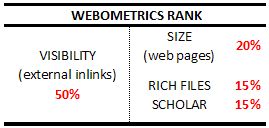
Their objective:
We intend to motivate both institutions and scholars to have a web presence that reflect accurately their activities. If the web performance of an institution is below the expected position according to their academic excellence, university authorities should reconsider their web policy, promoting substantial increases of the volume and quality of their electronic publications.
In the around 15,000 universities surveyed, 326 Indian institutions were included (compared to 891 Chinese and 671 Japanese institutions.)
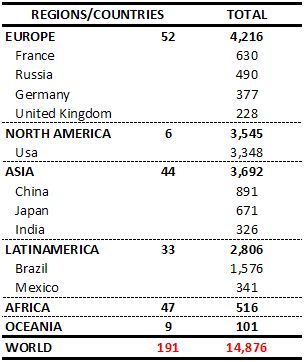
In the final 5,000 rankings, there were 30 Indian institutions. The top ranked Indian university was IIT Bombay (ranked 559 of 5000) and last to make it into that list was IIIT Allahabad (ranked 4723 of 5000). In the top 1000, US had 369, India had 4, and China had 17.
Unsurprisingly, 44 US institutions were ranked in the top 50. After all, the web and the internet were not only born in the US but the midwives were US universities.
(I am especially pleased to note these rankings: IIT Kanpur (995th in the world), Rutgers (28th), Berkeley (5th), and Stanford (2nd) — schools that I attended.)
As India is around a sixth of the world population, to be at par, India should have had around 600 universities in the top 5000 instead of the 30 it has. We do hear all the time that “India is an IT superpower.” Well, that claim will be more credible if its educational institutions actually did have something to do with the use of IT.
So the lesson for Indian institutions is that it is time to look sharp and get their act together on the web. Web presence ranking has a correlation with academic quality and prestige. I think that all of these must be and can be improved if — repeat after me — “we free the Indian education sector.”
(Thanks to Nitin Pai for the link).


Didn’t know you were from IITK. I am a student here at IITK. Anyway, I hardly think that increasing their web presence is hardly the highest of the administration’s concerns seeing as they are more busy on issues like internet bans and the like.
Vikram Singh
LikeLike
I feel sorry IIT Roorkee doesnt even make it to this list, and understandably so. Try http://www.iitr.ernet.in and go make some coffee while it loads iota of information.
LikeLike
From “Rating Colleges”
Good education…may be inversely proportional to many of the qualities now used to rank educational institutions.
Most ranking systems face backwards, using measure that no longer describe present realities or the role of the institution in relation to those realities.
I propose…five criteria:
– How much the institution consumes or discards per student…
– Management policies for materials, waste, recycling, purchasing, landscaping, energy use, and building…
– Does the curriculum provide the essential tools for ecological literacy? What percentage of its graduates know the rudiments of ecology?…
– Does the institution use its buying power to help build sustainable regional economies. What percentage of its food purchases come from nearby farmers? …To what extent are their funds invested in enterprises that move the world toward sustainability?
– Institutions should be ranked on the basis of what their graduates do in the world. On average what price will future generations pay for the manner in which…they live.
…Most colleges make serious efforts to discover who among their alumni have attained wealth. I know of no college that has surveyed its graduates to determine their cumulative environmental impacts.
-David W. Orr, Earth in Mind: On Education, Environment and the Human Prospect (1994)
LikeLike