
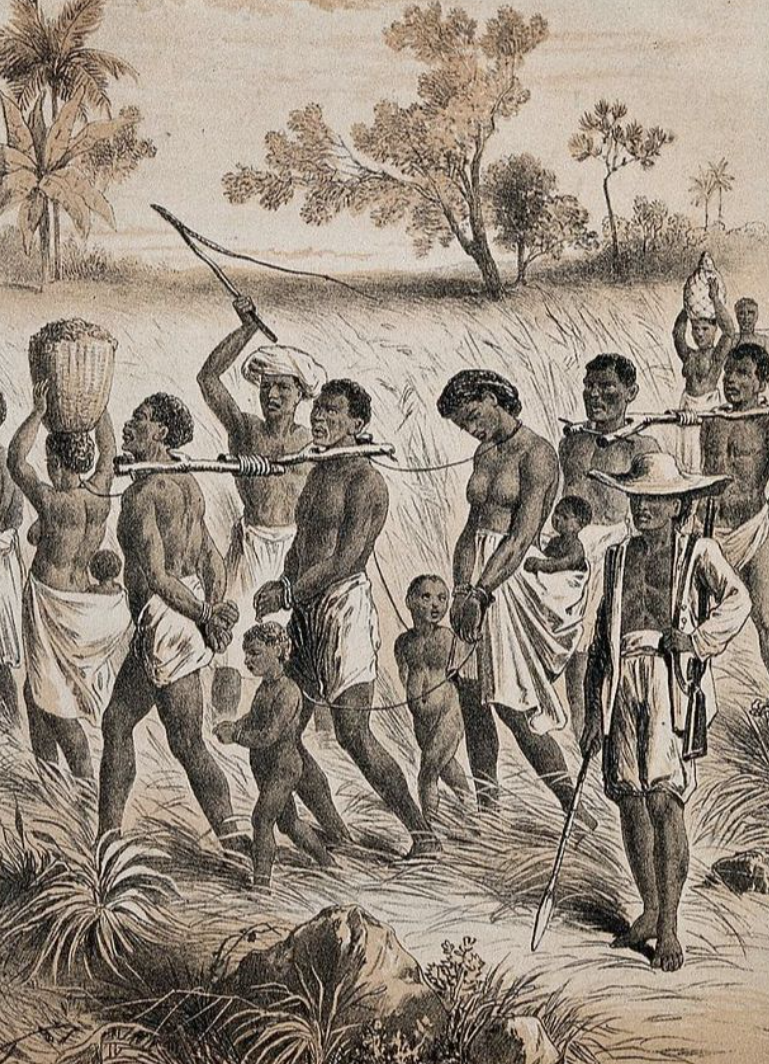
Slavery

Slavery is as old as civilization. As hunter-gatherers, humans could not have held slaves. Only with the advent of settled agriculture it became possible for some people to own other people. Every civilization has had the institution of slavery although one may get the impression that only the whites have enslaved blacks, and that the Americans in particular are guilty of the crime of slavery. 

Although that’s a common enough misconception, there’s no justification for it in this day of easy access to historical information. A quick question to any of the AI engines is all you need to learn about the awful history of slavery.

The Atlantic slave trade is the most cited but was neither unique nor even the worst. During the Atlantic slave trade, which lasted from the sixteenth to the nineteenth century, around 12 million Africans were put on slave ships, sailed across the Atlantic Ocean and sold into slavery.  Of this approximately 600,000 were transported to north America, which means that about 5% of all African slaves from the Atlantic slave trade were brought to America.

The Europeans did not capture slaves in Africa. The job of capturing Africans and selling them to Europeans was done by Africans. Africans enslaved Africans. They were the original slavers. Continue reading “Slavery”

Sundry Sunday

Looking north-east from the Evergreen area of San Jose. (Click to embiggen)

I looked at the title of this post and realized that the two words in it differ only in one letter. Funny, isn’t it? It’s going to be a sunny Sunday. Funny and sunny rhyme. I’m quite the wordsmith today. Which reminds me that I learned William Wordsmith’s 1804 poem Daffodils by heart in middle school and can still recite it by heart. Its final lines are the best:

“And then my heart with pleasure fills
And dances with the daffodils.”


So, what’s happening? Yesterday Courtenay drove down from Oakland to visit for a bit. Hadn’t seen her since January. She had tales of woe. Got fired from her job a few days ago; car’s leaking oil and could set her back a few thousand in repairs; husband and teenage son are tearing around the house breaking stuff; bills to pay; neighbors are being jerks, etc. But she’s a good sport and laughs it off.

You can take the girl out of Toledo, Ohio but you cannot take the Toledo, Ohio out of the girl, is what they say. Continue reading “Sundry Sunday”

Thomas Schelling

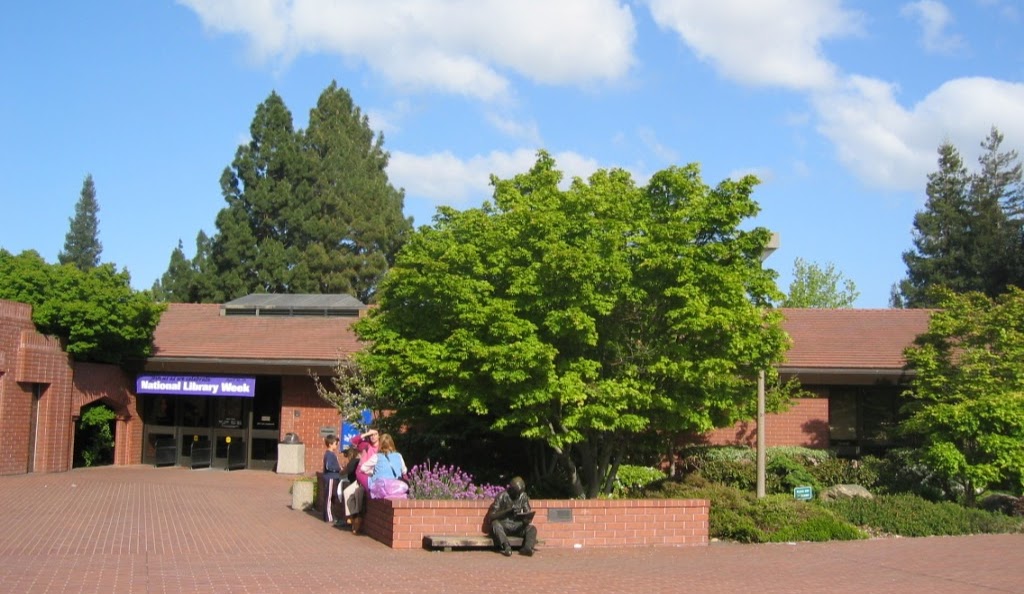
Sunnyvale Public Library (c. 1995) Click to embiggen

Life is a random draw. Much of life is contingent and it’s like a random walk with many unpredictable twists and turns. Many unforeseen events have taken me down roads that I had no inkling about even a few months before I embarked on an adventure. One of those lucky turns happened around 33 years ago.

I was at the Sunnyvale Public Library, waiting in line to check out a few books. SPL was close to home. I would go there a few times a month. While waiting to check out books, I randomly picked up a book from a sorting cart. It was titled “Micromotives and Macrobehavior.” I glanced at a few paragraphs and decided to borrow the book.

That evening, I started reading the book. In a day, I had read the book. I found it fascinating. The author, it turned out, was someone named Thomas Schelling. He was an economist. It dawned on me for the first time that I was an economist. Until that point, I had not only not known what economics was but I had no idea that I was actually an economist.

A few months later, I was telling about that to a friend of mine, VA, in Palo Alto. He said, “Hey, I think you should get a Ph.D. in economics!” That planted a seed. Continue reading “Thomas Schelling”

Wine and Bread

I love homemade bread, and I love red wines. I am partial to the cabernet sauvignon, merlot and pinot noir varieties. The first two are from the Bordeaux and the third from the Burgundy regions of France. They are also great places to visit, as I did many years ago.

My close friend and host — A in San Jose — occasionally bakes bread at home. A few days ago, we had some fresh out of the oven bread with Kerrygold Irish butter (from Costco, where else!) and paired it with some cabernet sauvignon (probably from Trader Joe’s.) The picture of the bread and wine appears at the top of this post. Click to embiggen. Continue reading “Wine and Bread”

AI’s view of this blog

I am impressed by AI models. They are amazing. We’ve come a long way from Eliza. If you’ve never heard of Eliza, it makes my point that we’ve come a long way. What’s Eliza? Let an AI answer.

“ELIZA is a pioneering AI program created in the mid-1960s by Joseph Weizenbaum at MIT. It was designed to simulate human-like conversations using simple pattern matching and substitution techniques. ELIZA’s most famous script, the DOCTOR script, mimics a psychotherapist by rephrasing user statements into questions, creating the illusion of understanding. Despite its limitations, ELIZA captured the imagination of users, leading to a phenomenon known as the Eliza effect, where people felt emotionally connected to the program, even though it was not genuinely intelligent. ELIZA laid the foundation for modern conversational AI and continues to influence the development of AI technologies today.” Continue reading “AI’s view of this blog”

Happy Thanksgiving

Thanksgiving day is special because unlike Diwali or Christmas, it is non-religious. It has a special appeal to me because the motivating emotion is one of gratitude.
I have a ritual which I do several times a day: I pause for a minute and focus my mind on how fortunate I am for all the unearned blessing I have. I thank the universe for conspiring in my favor. Certainly things could have been better but it could have been a lot worse too.

But today’s special. I can be specific about what I am grateful about. First of all, I am thankful for my friends and family. I don’t have many but those that I have are wonderful. They give without measure and I do my best to reciprocate. You know who you are. Thank you. Continue reading “Happy Thanksgiving”

New York City

Civilizations self-destruct. The English historian, Arnold J. Toynbee, wrote, “Civilizations die from suicide, not by murder.” That goes for cities and countries too.
The West is facing an existential threat that is mainly brought on by a mix of suicidal empathy and collective guilt. Both of those are consequences of ignorance of history and stupidity. That said, I will not write off the West yet. The West has successfully triumphed over evil before. The West will defeat Islam too. I think the darkest hour has come but dawn is about to break.

What gives me hope? The young. Here’s one: @kiyahwillis. Her X profile says she is “Ex- Woke Leftist, Ex-Nonbinary | Current advocate for the secular liberal right | Fellow @ObjStdInstitute, Contributor @FreeBlckThought”

She posted the following on X: Continue reading “New York City”

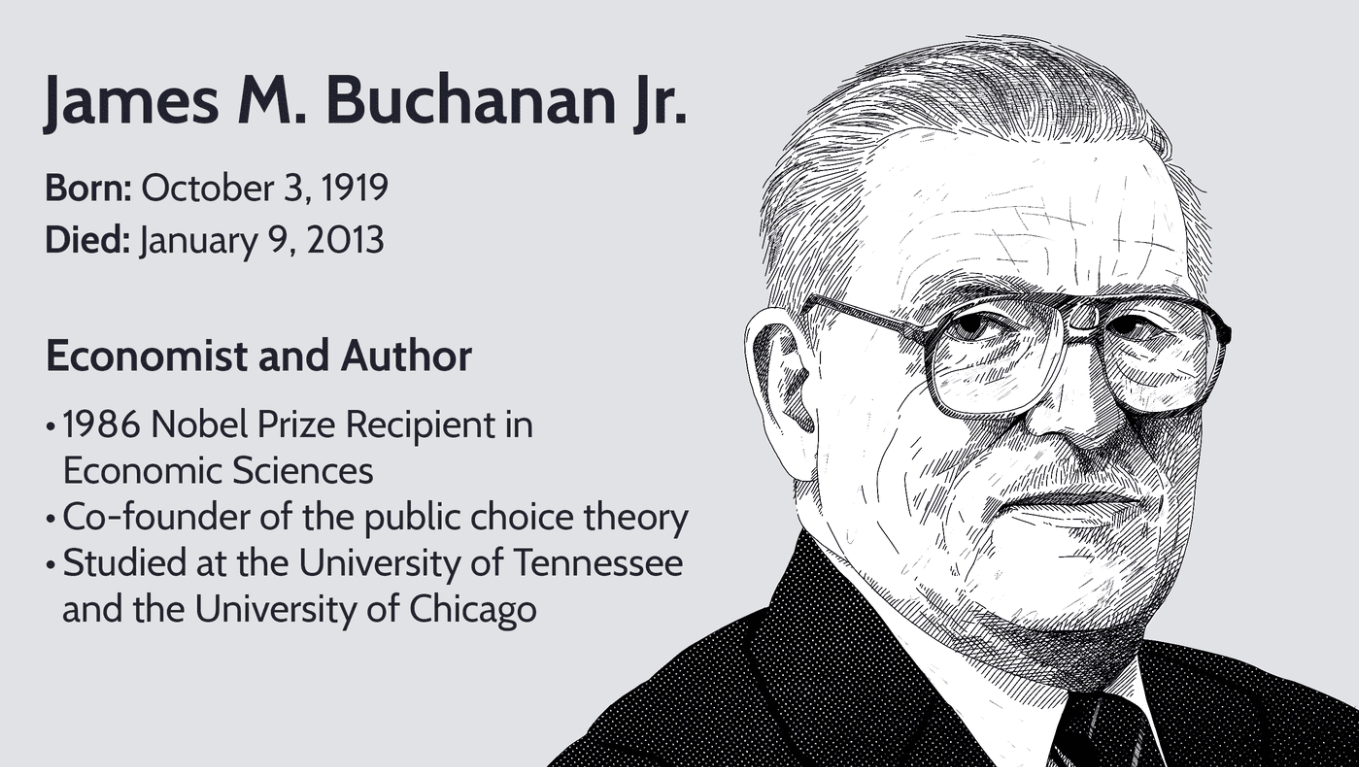
The Political Economy of James Buchanan

Among the many economists I have deep respect and reverence for are the classical economists like Adam Smith, David Hume, David Ricardo, and John Stuart Mill. Among the neoclassicals are William Stanley Jevons, Leon Walras, Carl Menger, Alfred Marshall, Vilfredo Pareto, Francis Edgeworth, and Lionel Robbins.

Jevons, Walras, and Menger were the founding figures of the marginalist revolution that established neoclassical economics, with Jevons and Walras independently developing the theory of marginal utility in the 1870s.

Alfred Marshall synthesized classical and neoclassical ideas in his influential textbook Principles of Economics. Pareto, a successor to Walras in Lausanne, Switzerland advanced the field, especially in general equilibrium theory. Edgeworth developed a mathematical economic theory based on utility maximization, and later economists like John Hicks and George Stigler helped broaden the scope of neoclassical thought. Continue reading “The Political Economy of James Buchanan”

Cost

We all understand what price means — whatever we have to pay for it. We also know that the price has something to do with the cost and we often use the two words interchangeably. But it is not clear what precisely is the difference between them.

For example, when we buy a widget for $5 — the price — but it could very well be that its cost of production and distribution was above or below that price. But generally, on average the price of stuff closely tracks its cost. If the revenue obtained from sales is below cost, the product or the firm is forced out of the market.

Where does cost arise from? Here I argue that the cost of anything is ultimately the cost of the energy that went into its production and distribution. Therefore, prices fall when energy costs fall, and vice versa. Continue reading “Cost”

Energy Matters

I find planes fascinating. Those humongous machines are capable of flying thousands of miles at speeds just below the speed of sound, cruising over  35,000 feet above MSL, with hundreds of passengers in comfort and safely at prices that billions of people can afford.

If in the year 1900 — that wasn’t too long ago — you had told someone that traveling at 500 miles per hour would be commonplace by the year 1970 (the year the jumbo jet Boeing 747 entered service), they would worry about your sanity. Furthermore, if you insisted that people would be traveling around 7 miles above the earth while crossing continents, they would have you committed to a lunatic asylum.

It’s hard enough to get up to 7 miles above ground. But on top of that, to move at 500 miles per hour? That’s two impossible feats at the same time. That’s unbelievable squared.

I often meditate on the fact that these commercial jetliners evolved from their ancestral form around the year 1900 in less than half a century. Their progenitor was built out of wood, fabric and wires by a couple of bicycle mechanics from Dayton, OH. They started with experimenting with gliders for several years, and then having figured out the physics of flight, added an engine that they built in their shop. The first powered flight was on 17th December 1903 in Kitty Hawk, NC. Continue reading “Energy Matters”